
Introduction
Slow load times. A homepage that looks like it’s stuck in 2015. Traffic that used to convert and now just… doesn’t. If any of that sounds familiar, you’re probably wrestling with the website redesign vs rebuild question, and you’re not alone. It’s one of the most common decisions business owners run into once a site starts underperforming, whether they’re a national brand or a local business searching for website design Sacramento has to offer. Get it wrong and you’re out months of time and a lot of budget, so before you sign off on anything, it’s worth understanding what each option actually means.
Get it wrong and you’re out months of time and a lot of budget, so before you sign off on anything, it’s worth understanding what each option actually means.
Signs You Need a Redesign or a Rebuild
Here’s the thing: not every website problem needs the same fix. Some are surface-level and cheap to solve. Others are baked into the foundation, and no amount of polish will fix them. Companies looking into professional web design services usually start right here, trying to figure out which bucket their site falls into before they even request a quote.
Visual and branding issues (usually a redesign):
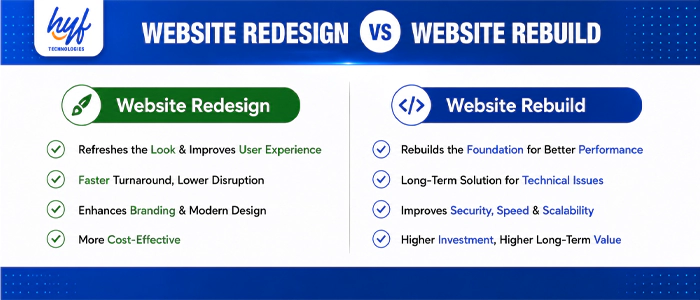
- The design looks dated next to competitors
- Navigation is cluttered, confusing, or just hard to use
- Branding, colors, or fonts don’t feel consistent anymore
- Nothing’s technically broken, it just feels tired
Technical and structural issues (usually a rebuild):
- Pages load slowly no matter how much you compress images
- The site isn’t genuinely mobile-friendly
- The software behind it is outdated and carries real security risk
- You can’t add a feature without something else breaking
A lot of companies searching for enterprise web design solutions end up in this second bucket, especially when the site was built years ago on a platform nobody’s updated since.
Key Differences Between Redesign and Rebuild
Here is how both approaches compare on the factors that matter most:
| Factor | Redesign | Rebuild |
|---|---|---|
|
Scope |
Visual and content changes
|
New code, platform, or architecture |
|
Backend |
Stays the same |
Replaced or rebuilt |
|
Timeline |
Shorter |
Longer |
|
Best for |
Outdated look, weak branding |
Slow speed, security gaps, scaling issues |
|
Disruption |
Minimal |
More involved, but solves root issues |
Website Design Trends Worth Knowing
Design trends shift constantly, and lately, more of them are pushing businesses toward a rebuild rather than a quick refresh.
Mobile-first design isn’t optional anymore. Most visitors are on their phones, so if your site was designed desktop-first years ago, it’s probably showing. Page speed matters more too; people expect near-instant loading now and won’t wait around for anything that lags. On the visual side, cluttered, text-heavy layouts keep losing ground to cleaner, more minimal ones with obvious calls-to-action. And a growing number of competitive firms are experimenting with AI-driven personalization, adjusting content based on how a visitor behaves on the page.
But the biggest shift isn’t really about aesthetics at all. It’s legal. Under the Americans with Disabilities Act (ADA), businesses are increasingly expected to meet Web Content Accessibility Guidelines (WCAG) standards. That’s no longer a nice-to-have. It’s a compliance issue, and companies that skip it are getting hit with a growing wave of web accessibility lawsuits. Here’s the catch: an older site that wasn’t built with WCAG in mind usually can’t be patched into compliance through a simple redesign. It typically needs a rebuild.
So when you’re vetting a professional web design agency, don’t just look at the portfolio. Ask how their engineering process handles compliance and speed, because that’s where the real difference shows up. According to research highlighted by HubSpot, a B2B site that loads in 1 second converts at roughly 3x the rate of one that takes 5 seconds. Code performance isn’t a technical footnote here, it’s directly tied to revenue.
That’s really the gap between top web design agencies and everyone else. Leading B2B development firms bake compliance, speed, and scalability into the process from day one instead of bolting it on later.
Conclusion
There’s no universal answer here, and honestly, anyone who tells you otherwise is probably trying to sell you something. If your site looks outdated but still runs fine, a redesign gets your brand looking current without disrupting what already works. If it’s slow, insecure, or can’t keep up with today’s compliance and performance expectations, a rebuild is going to save you more headaches in the long run. Either way, the right call comes down to an honest look at where your site actually stands, not a guess.
Get a Free Website Audit
Not sure which one you need? We offer a free audit that looks at your site’s performance, speed, and ADA compliance, no strings attached. We’ll check your technical foundation, how it holds up on mobile, and where it stands on accessibility, then give you a straight answer. No upsell, no runaround. Reach out and let’s find out where your site actually stands.