

Voice search optimization is how businesses get chosen when someone asks Siri, Alexa, or Google a question out loud. Unlike typed search — where people use short phrases — voice queries are full sentences, usually questions. Businesses that optimize for this show up more often in featured snippets, local results, and “near me” searches. It’s one of the fastest-growing ways customers find and contact businesses today.
Someone just asked Siri to find the best web designer near them. Was your business the answer?
Think about that for a second. A potential customer — right now, in Sacramento, Los Angeles, or anywhere in California — is holding their phone and asking it a question. Not typing. Talking. And in that moment, your business either shows up or it doesn’t.
Over half of all global searches are expected to be voice-based by 2025. In fact, recent data shows that 58% of consumers already use voice search specifically to find local business information, making it a critical tool for capturing ready-to-buy customers.
Here’s what this post covers: what voice search optimization actually means, how it’s different from regular SEO, and six tactics you can start using right now — even if you’re not a tech expert.
What is voice search optimization — and why does it matter right now?
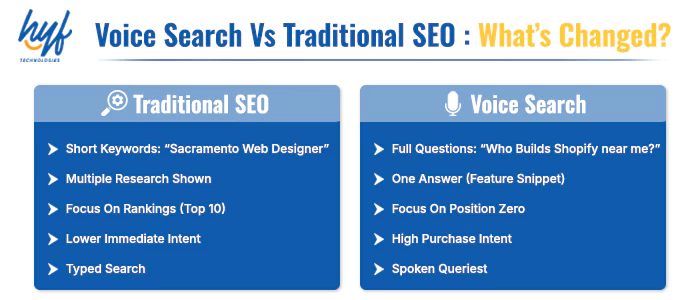
Voice search optimization is the practice of structuring your content so voice assistants can understand it, trust it, and read it aloud as an answer. That’s the key difference from traditional SEO. With text search, someone types “Sacramento web designer.” With voice search, they say “who’s the best web design company near me that builds Shopify stores?” Longer. More specific. Completely different phrasing.
For small businesses, ecommerce brands, and digital marketing clients in California, this matters because voice search has the highest local purchase intent of any search type. People who ask their phone a question are usually ready to act — not just browse.
Voice Search Strategies That Put Your Business Ahead
These are the approaches that consistently deliver results for real businesses.
Write for questions, not keywords.Voice queries almost always start with who, what, where, when, or how. Build content around those full questions — not just isolated phrases like “web design California.”
Target featured snippets.Voice assistants read one answer aloud — usually the featured snippet at position zero. Structure your content with a clear question as a heading, followed immediately by a 40–60 word direct answer. That format wins.
Keep your Google Business Profile current.This is the single biggest local voice search lever most businesses ignore. Accurate hours, categories, address, and a filled-out Q&A section dramatically increase your chances of being the answer when someone asks “find me a [service] near me.”
Fix your page speed and mobile experience.Voice searches happen on phones. A site that loads in five seconds on mobile won’t get pulled as a voice result — full stop. Core Web Vitals matter here more than most people realize.
Add schema markup.Schema code tells search engines exactly what your content means. FAQ schema, LocalBusiness schema, and Implementing Product schema gives search engines the structured context they need to surface your content in voice results. Many businesses overlook this entirely — if yours hasn’t been set up yet, that’s a gap that’s quietly costing you visibility every single day.
Build a dedicated FAQ page.A well-built FAQ page targeting real customer questions is one of the highest-ROI pages you can add to your site for voice search. Cover the questions your customers actually ask — not just the ones that sound good on paper.
Voice search optimization for ecommerce businesses
Ecommerce brands have a real edge here — if they take it. Customers are asking questions like “where can I buy organic dog food near Sacramento” or “what’s the best skincare product for dry skin” before they even open a browser. Product pages with conversational descriptions, proper product schema, and FAQ content are far more likely to show up in those results. Whether you’re on Shopify, WooCommerce, Magento, or BigCommerce, the fundamentals are the same: speak your customer’s language, answer their questions directly, and make sure your site loads fast on a phone.
FAQs
Standard SEO is built around compact keyword phrases — think “Sacramento web designer.” Voice search works differently. People speak in full, natural sentences, asking things like “who builds Shopify stores near me and has good reviews?” That shift in phrasing changes everything about how your content needs to be structured.
Voice searches are usually made with strong intent. People asking questions out loud are often looking for immediate solutions, which means they’re more likely to contact a business, visit a store, or make a purchase quickly.
Absolutely. A large share of local voice searches result in a visit or purchase within 24 hours. For businesses competing in Sacramento, Los Angeles, and San Francisco, voice search is one of the most direct ways to capture ready-to-buy customers.
Voice search isn’t coming — it’s already here, and your customers are already using it. The businesses showing up in those results aren’t doing anything magical. They’ve just optimized for how people actually search today. If you’re not sure where your site stands, our team at HYF Technologies offers a SEO audit for California businesses. Reach out at HYF Technologies— we’ll tell you exactly what needs attention.