
Search visibility in 2026 is no longer driven by keywords alone. With AI-powered results and algorithm updates focused on credibility, E-E-A-T SEO has become one of the most important ranking foundations. Google now evaluates not just what you publish, but who is behind it and whether your website demonstrates genuine experience, expertise, authority, and trust.
In earlier years, SEO strategies prioritized backlinks and on-page optimization. Today, those tactics only work when supported by strong trust signals. Topical authority has emerged as a key differentiator, especially in competitive niches. If your brand cannot demonstrate real credibility, AI-generated search features will favor competitors who can. E-E-A-T SEO in 2026 is about proving legitimacy in measurable ways.
What Is E-E-A-T in SEO? (And Why It Matters More in 2026)
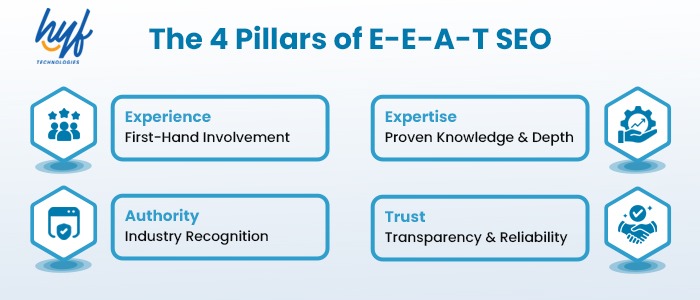
E-E-A-T stands for Experience, Expertise, Authority, and Trust. These four elements form the framework Google uses to evaluate content quality and credibility.
Experience refers to first-hand involvement with a topic. Expertise reflects subject knowledge or professional qualifications. Authority measures how widely recognized your brand or authors are within an industry. Trust evaluates transparency, factual accuracy, and overall reliability.
Originally introduced as E-A-T in Google’s Search Quality Rater Guidelines, the additional ‘Experience’ signal was added — as outlined in Google’s Search Quality Rater Guidelines. In 2026, experience expertise authority trust signals are not just theoretical quality guidelines—they directly influence ranking systems and AI visibility.
The Four Pillars of E-E-A-T SEO in 2026:
Lorem ipsum dolor sit amet, consectetur adipiscing elit. Ut elit tellus, luctus nec ullamcorper mattis, pulvinar dapibus leo.
| Pillar | Core Focus | What Google Looks For in 2026 (Trust Signals That Rank) |
|---|---|---|
|
Experience |
Demonstrated first-hand involvement |
Original data, case studies, real-world testing, screenshots, documented results, personal insights, before/after proof
|
|
Expertise |
Proven knowledge and depth |
Author credentials, structured author schema (Person markup), detailed bios, niche specialization, consistent topic focus
|
|
Authority |
Industry recognition and influence |
High-quality relevant backlinks, brand mentions (linked & unlinked), digital PR, citations, strong topical authority clusters
|
|
Trust |
Transparency and reliability
|
HTTPS, clear contact details, editorial policy, privacy policy, factual accuracy, updated content, compliance with Google spam policies
|
Experience — The Signal That Sets 2026 SEO Apart
Experience is the clearest separator between high-performing content and generic summaries. Google increasingly prioritizes pages that show real testing, documented results, or practical application.
For example, content that states, “I tested this strategy for 60 days and here are the results,” carries more weight than a compilation of third-party opinions. Screenshots, original data, case studies, and transparent lessons learned all reinforce authentic experience.
Websites that consistently publish first-hand insights naturally strengthen their topical authority. Experience proves your content is rooted in action, not speculation.
Expertise — How Google Evaluates Author Credibility
Expertise is about depth of knowledge and demonstrated competence. In E-E-A-T SEO, this often appears through detailed author bios, professional credentials, and structured schema markup connecting content to real individuals.
Google favors niche-focused sites that repeatedly cover a subject area in depth. Broad, surface-level publishing weakens perceived expertise. For YMYL topics especially, higher standards apply—qualifications, accurate citations, and professional background become critical ranking signals.
Building expertise takes consistency. The more focused your content strategy, the stronger your authority signals become.
Authority — Building Topical Authority That Ranks
Authority develops when others recognize your knowledge. Backlinks still contribute, but quality and relevance now outweigh sheer volume. Brand mentions, citations, and digital PR also strengthen authority—even when links are not included.
Topical authority is achieved through structured content ecosystems. Pillar pages supported by related cluster content signal comprehensive subject coverage. Instead of publishing disconnected articles, successful sites build organized knowledge hubs.
Over time, this depth reinforces both authority and trust, making rankings more sustainable.
Trust — The Foundation Every Ranking Site Needs
Trust supports every other E-E-A-T element. Without it, experience and expertise lose impact. A secure HTTPS website, transparent contact information, accessible privacy policies, and visible editorial standards are now essential—not optional.
Trust also includes factual accuracy and honest positioning. Overstated claims, anonymous authorship, or misleading content can damage long-term visibility. In modern E-E-A-T SEO, trust is the baseline expectation for ranking success.
How to Audit Your Site’s E-E-A-T Signals Right Now
Start by reviewing whether your top pages clearly demonstrate experience, expertise, authority and trust. Are authors visible and credible? Does the content include original insight? Is your backlink profile relevant and reputable?
Assess whether your site structure supports topical authority through internal linking and content clusters. Confirm that schema markup is implemented correctly and that policies are transparent.
Regular audits help prevent of trust signals before rankings decline.
E-E-A-T for AI Overviews — How to Get Featured
AI Overviews favor structured, definition-style content that clearly demonstrates authority and credibility. To improve eligibility, place concise explanations near the beginning of sections, use structured formatting, and ensure schema markup supports your content.
AI systems prioritize pages with strong experience expertise authority trust signals because they reduce uncertainty in automated summarization. Clear definitions, fact-based statements, and structured formatting increase extraction likelihood.
Common E-E-A-T Mistakes to Avoid in 2026
One common mistake is relying solely on backlinks without strengthening topical authority. Another is publishing AI-generated content without adding human oversight or first-hand experience. Thin author pages and inconsistent niche focus also weaken expertise signals.
Ignoring brand mentions and public reputation can further limit authority growth. E-E-A-T SEO requires a holistic approach—not isolated tactics.
Conclusion
In 2026, E-E-A-T SEO is the foundation of sustainable rankings. Search engines prioritize websites that clearly demonstrate experience, expertise, authority, and trust. Strong topical authority, transparent authorship, and real-world proof are no longer optional—they are ranking essentials.
If your content proves credibility at every level, visibility follows. Build trust signals intentionally, and your SEO performance will grow consistently over time.
FAQs
Trust, without question. You could have the world’s leading expert writing your content, but if your site lacks HTTPS, hides who’s behind it, or publishes inaccurate information, Google simply won’t rank it.
Prove you’ve done the thing. Share original photos, document your own case studies, talk about what went wrong and what you learned. Unique, personal data goes a long way — it’s the kind of stuff no one else can replicate.
It can, but not on its own. Pure AI output tends to fall flat on the Experience and Expertise fronts. You need a human to fact-check it, add personal perspective, and make it feel like it came from someone who actually knows the subject.
It’s about becoming the go-to resource for your niche rather than dabbling in everything. The way you build it is by creating content clusters — a main topic page supported by a web of in-depth articles covering every related sub-topic, all linked together.
Yes, and it needs to be a proper one. In 2026, a detailed bio paired with Author Schema is essentially non-negotiable. It ties your content to a real, credentialed person — which is exactly what Google’s systems are looking for when assessing expertise.