
Digital advertising has fundamentally shifted. With Google’s AI Overviews now dominating the top of search results, relevance is no longer just a “best practice”—it is a survival requirement. Generic website pages are being filtered out by AI models that prioritize specific, structured, and high-intent information.
To drive real conversions in 2026, high-performing PPC landing pages must move beyond simple keyword matching and align deeply with both user intent and AI-driven expectations. This guide covers seven essential steps to building landing pages that win in the era of AI-driven search.This guide focuses on practical principles of PPC landing page optimization designed for modern AI-driven search environments.
The Power of Dedicated Landing Pages: Maximize ROAS
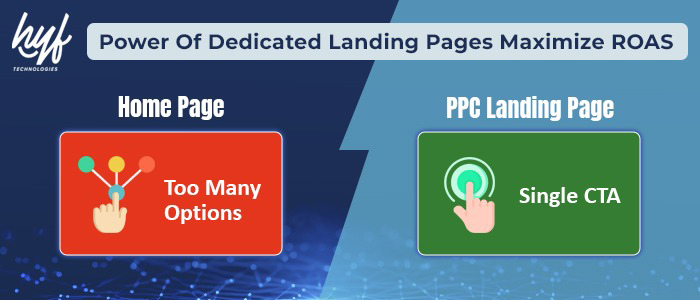
Many PPC campaigns fail the moment the click happens by sending paid traffic to a generic homepage. Homepages are built for exploration; landing pages are built for conversion.
Dedicated landing pages solve this by focusing on a single goal. When pages are tailored to specific ads, they deliver a stronger Return on Ad Spend (ROAS) through laser-focused messaging and clear intent alignment.
Step 1: Achieve Perfect Message Matching & AI Relevance
The core of successful digital advertising lies in relevance. When a user clicks your Google Ad, they carry a specific expectation—a promise made by your ad copy.
If your PPC landing page fails to immediately confirm that promise, the user bounces. In 2026, this “bounce” signals to Google’s AI that your page is not a helpful result, which tanks your Quality Score.
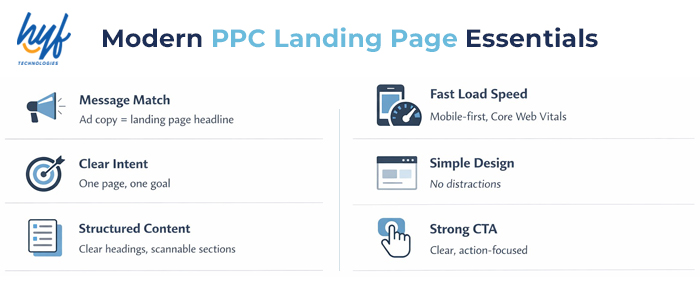
Headline Alignment: Use compelling headlines that mirror the exact text of your ad copy.
Visual Continuity: Design must deliver instant relevance. Visitors (and AI vision models) respond best to realistic imagery that matches the specific offer.
Step 2: Define Conversion Goals by User Intent
Relevance is useless without a clear objective. To maximize ROAS, you must define precise conversion goals for every page.
Brand Awareness: Focus on building credibility, trust and structured data that AI can easily parse.
Direct Response: Demand immediate action with high-intent copy.
Customizing your audience targeting based on specific intent is a core PPC best practice for success in paid search and display advertising.
Step 3: Craft Compelling, Structured Headlines
Your headline is the single most important element. In the age of AI Overviews, headlines should be clear, authoritative and utilize proper Header Tags (H1). This helps AI models understand the primary purpose of your page.
Confirm the Click: Your headline must reduce cognitive dissonance.
The 65% Rule: Studies confirm that dedicated landing pages with high message matching convert up to 65% higher than general website pages.
Step 4: Utilize Intent-Driven Imagery & Technical Speed
Images are non-negotiable, but they must be optimized for 2026 performance standards.
Avoid generic stock images and use realistic imagery aligned with the offer. Slow load times are conversion killers. As of 2026, Google’s AI models prioritize pages that meet strict Core Web Vitals standards.
Ensure your images are compressed and served in next-gen formats like AVIF or WebP to protect your ROAS.
Step 5: Optimize Design for Zero Friction
A complex design is the fastest way to kill a conversion.
Clean layouts limit exits and distractions while guiding the user toward a single action. With the majority of AI-driven searches occurring on mobile devices, responsive and fast design is mandatory for paid search traffic.
Step 6: Use Clear, Actionable CTAs
The Call to Action (CTA) is the culmination of your efforts.
Avoid generic terms like “Submit.” Use specific CTAs such as “Get My Free 2026 Strategy” or “Claim My Discount.” Ensure the CTA is visible at multiple points on the page so the user never has to search for the next step.
Step 7: The Optimization Feedback Loop
Landing page optimization is a continuous, data-driven cycle. In 2026, you must track how efficiently your ad budget generates revenue in the face of rising CPCs.
Systematically test headlines, imagery and CTA buttons. Use analytics to see how users coming from AI Overviews interact differently compared to traditional search users. Continuous testing and analytics-driven refinement are the foundation of sustainable PPC conversion rate optimization in competitive paid search environments.
Frequently Asked Questions
PPC landing pages are hyper-focused on a single conversion goal and specific keyword usage to maximize Quality Score. Organic pages are often broader to capture various long-tail search queries.
No. In 2026, using a homepage for PPC is a recipe for low ROAS. Always use a dedicated landing page tailored to the specific ad offer.
AI Overviews summarize content for users. If your landing page is structured well using clear headers and concise answers, the AI is more likely to cite your page as a source.